
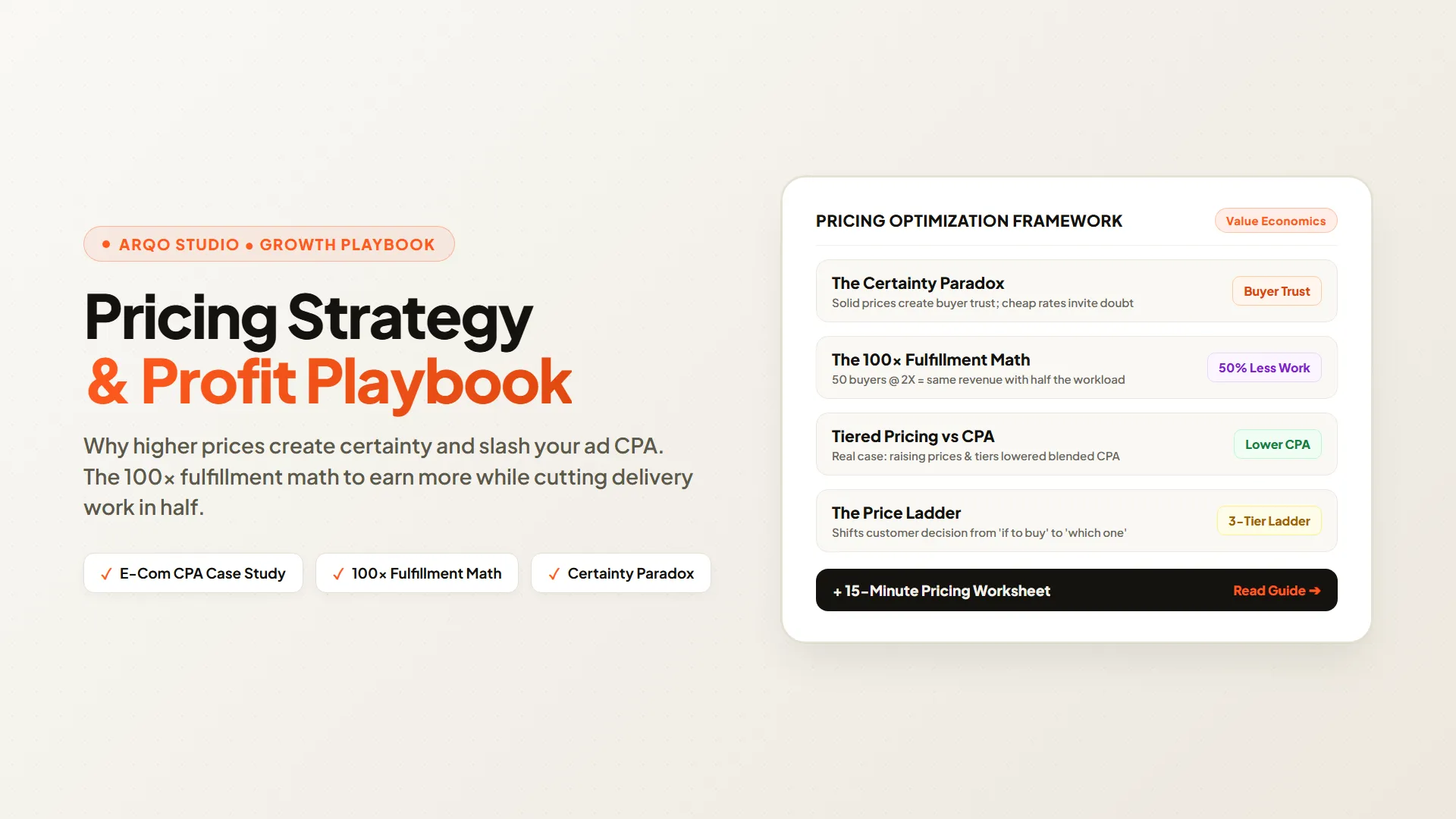
Pricing is the ultimate lever in modern business. It dictates who your customers are, how much you can spend on customer acquisition, and whether you run a frantic low-margin treadmill or a profitable, defensible enterprise.
Yet most businesses pick their prices out of fear—pegging their rates 10% below the nearest competitor and praying for volume.
Here is why underpricing destroys client trust, and how to price your offerings for maximum long-term profitability.
1. Why Cheap Pricing Destroys Both You and Your Customer
When you charge too little, three toxic things happen simultaneously:
- You Attract High-Maintenance Buyers: Bargain hunters demand the most customization, complain the loudest, and have the highest churn rates.
- You Starve Fulfillment: Low margins prevent you from hiring senior talent, buying top-tier equipment, or investing in deep research. As a result, deliverables suffer.
- The Customer Gets Worse Results: When a client pays ₹10,000 for a course or service, they barely pay attention. When they invest ₹2,50,000, they implement every single instruction with relentless focus.
The Certainty Paradox: In high-value goods and services, price is interpreted as a proxy for competence. When your price is artificially low, buyers assume there is a hidden flaw.
2. My E-Commerce Mistake: How Raising Prices Dropped My CPA
Early in my e-commerce journey, I believed the common myth: “If I make my product cheaper, more people will buy, and my Meta CPA will drop.”
I was selling apparel priced at ₹799. My cost per purchase was ₹450. After shipping and manufacturing, I was barely making ₹80 per parcel.
I decided to run a radical test: I discontinued the discount lines, introduced premium heavy-gsm fabric, and priced the core line at ₹1,499 and limited editions at ₹1,999.
What Happened Next:
- Conversion Rate Stayed Flat or Rose: Premium buyers didn’t flinch. In fact, gifting and word-of-mouth increased.
- Meta Ad Algorithm Optimized Better: Because the average basket value surged to ₹2,800 (bundles of 2), Meta had more auction margin to bid for higher-quality audiences.
- Blended CPA Dropped: Higher-intent shoppers trusted the brand. Net profit margins jumped by over 400%.
3. The 100x Fulfillment Math: Halve Your Client List, Double Your Profit
Consider two agency models:
| Metric | Agency A (Low Ticket) | Agency B (Premium) |
|---|---|---|
| Monthly Retainer | ₹25,000 | ₹1,50,000 |
| Clients Required for ₹15L/mo | 60 Clients | 10 Clients |
| Account Managers Needed | 6 Staff | 1 Senior Strategist |
| Client Communications Overhead | Chaos / High Burnout | Calm / Deep Focus |
| Churn Rate | 15% / month | 2% / month |
Agency B makes the exact same gross revenue with one-sixth the client volume. They can afford to over-deliver, provide white-glove communication, and generate case studies that bring in inbound referrals on autopilot.
4. Practical Rules for Setting Your Prices
Rule 1: Know Your True Cost Floor
Never price based on gross margin alone. Calculate your Fully Loaded Delivery Cost:
- Software and tool subscriptions
- Team member hours
- Client onboarding overhead
- Ad spend buffers and payment gateway fees
Rule 2: Anchor Against the Cost of the Problem
If solving a B2B company’s lead-flow issue generates ₹25,00,000 in annual contract value, charging ₹3,00,000 to solve it is not “expensive”—it is an 8x return on capital. Always anchor against the financial upside of the outcome, never your hourly input.
Rule 3: Use the Good-Better-Best Pricing Tier
Never give a prospect a binary “Yes / No” decision. Give them a choice of how they want to work with you:
- Core Tier: Essential deliverable, self-directed onboarding.
- Growth Tier (Recommended): Full execution, weekly reporting, dedicated manager.
- Enterprise / VIP Tier: Accelerated turnaround, executive access, custom integrations.
When presented with three options, 65% of buyers naturally gravitate toward the middle tier, and 15% will instinctively buy the most expensive option simply because they want the best.